
founder blogging
The Founder's Guide to Blogging Without Hiring a Writer
Boris Kwayep is the founder of PersonnaPress, building tools that help founders and marketers publish content that sounds like them.
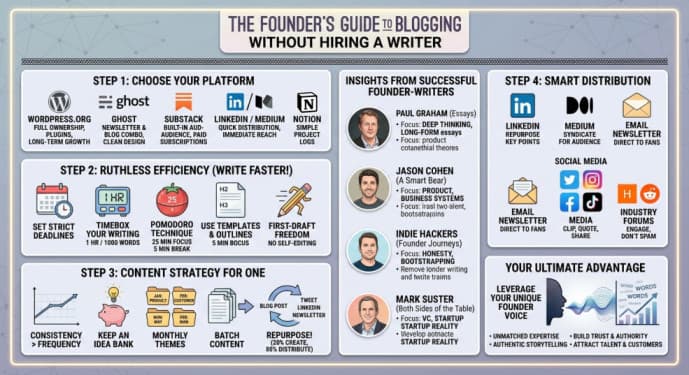
The Founder's Guide to Blogging Without Hiring a Writer
TL;DR: Post consistently (1 blog per week), use Claude to draft from your own notes, and review before publishing. Your expertise and perspective matter far more than perfect prose. Quality content compounds over time, delivering real ROI. AI is your research and first-draft assistant, not your voice.
Blog is the #1 ROI-generating marketing channel for founders. Not paid ads. Not social media. Blogs. Yet only 35.1 percent of small business websites have one, according to Elevate Web's 2026 audit of 4,407 sites. The gap is real. And if you've been stuck thinking you need to hire a professional writer to fill it, you've been wrong.
Why You Already Have Everything You Need to Blog
You know your business better than anyone ever will. Your expertise is the only differentiator that matters. After 2 years of posting 1 blog per week and 5 social posts weekly, I learned something that changed everything: people don't evaluate your content based on semicolons or vocabulary. They evaluate you based on who you are and what you actually know. That's it. Nothing more, nothing less.
Your audience doesn't need perfect grammar. They need real insights. They need to understand why you built what you built, what mistakes you made, and what actually works. Only you have that knowledge. A hired writer, no matter how skilled, can only approximate it. When you publish your own perspective, you stop sounding like a robot. Your voice ranks differently in search. People connect with it differently too.
And here's what changed my output: I stopped trying to write everything from scratch. Instead, I leverage raw material from my actual work. Client calls. Customer emails. Product feedback. One blog I wrote 2 months ago from my personal website, borisbuilds, generated 46 clicks that led to 10 sales because it explained a real problem I'd solved.
Repurpose Everything You Already Know
Your notes are everywhere. Emails to your team. Slack messages explaining why you made a decision. Call transcripts. Customer support tickets. These are your blog posts waiting to be written. I gather all of this material, organize it by topic, and hand it to Claude for structuring. Claude is the AI model I prefer for blog writing; it outperforms ChatGPT, Gemini, and Manus for this specific task.
But here's the critical move: I don't just accept Claude's output. I add specific instructions. Keep my tone. Maintain my perspective. Target these founders specifically. Add a CTA that drives this outcome. That's your only job in the drafting phase. Give clear instructions, then let the AI handle research and paragraph organization. You still own the voice.
Structure Your Post Before You Draft
Before Claude sees anything, I do keyword research. I ask two questions. First: does my audience actually want this information? Second: what words do they type into Google to find it? Use the free Google Keyword Planner to discover search volume. I found 1,200+ monthly searches for "AI Writer for startups." That number alone told me what to write. For deeper analysis, Semrush provides granular reports and monitoring that the free tools can't match.
Once you've got keywords, structure your outline. H1, H2 sections with a clear angle. Your outline becomes the prompt. Claude fills in the rest. But you're directing the architecture, not letting AI default to whatever it thinks is best. This is where your voice lives in the structure itself.
Review Is Non-Negotiable
Nothing publishes without you. Review the full draft. Approve specific sections. Reject weak paragraphs. Rewrite the intro if it doesn't sound like you. This step is where "sounds like you" actually happens. I use Microsoft Word for grammar and vocabulary corrections. If your budget allows, Grammarly offers a humanizer feature that catches robotic phrasing before readers ever see it. I tested both tools for a few months. Both work. Grammarly costs money but catches more subtle tone issues.
Consistency Creates Compound Returns
I post every Monday. Every single week. Not because it's easy. Because the schedule works. I started rushing content out without enhancing it. My impressions were flat. After I shifted to quality over speed, everything changed. Posts started getting impressions I'd never seen before. The traffic didn't come from week one. Or week four. It took more than 3 months before I saw results compound. But by month four, each new post benefited from the foundation I'd built.
Consistency matters more than perfection. Pick a schedule you can sustain. Weekly works for me. Some founders prefer bi-weekly. The cadence doesn't matter. Sticking to it does. When you publish on the same day every week, Google's crawlers know to expect content from you. Your audience knows when to check. Your blog becomes a signal that you're serious about sharing what you know.
I use PersonnaPress to post directly to my WordPress site; the friction disappeared. One click publishes my reviewed draft. I don't toggle between tools. I don't manage multiple logins. The extension handles formatting, meta descriptions, and cross-platform distribution. Your voice, ranked and published.
The Real ROI You're Missing
According to HubSpot's 2026 State of Marketing Report, blogs are the #1 ROI generating marketing channel for marketers overall, beating paid social. Meanwhile, 85 percent of marketers now use AI tools for content creation, and 68 percent of businesses report increased ROI in content marketing specifically because of AI-enabled workflows. You're not behind the curve by using AI. You're behind by not using it strategically.
The blogging gap exists because founders assume they can't do it themselves. They think they need a $3,000 per month freelancer. They think their writing needs to be perfect. They think it takes too long. None of that is true. What takes time is consistency. What requires investment is thoughtful review. What demands effort is actually understanding your audience's search behavior before you write. The writing itself, with AI handling the draft, takes hours, not weeks.
Frequently Asked Questions
How long does it take to see results from blogging?
Expect more than 3 months before traffic compounds meaningfully. Google takes time to crawl, index, and rank new content. But after month four of consistent posting, you'll notice a cumulative effect. Each new post benefits from the authority you've built.
What if I don't know what to blog about?
Start with the problems you solve every day in sales calls, support emails, and team conversations. These are real questions your audience is asking. Use Keyword Planner to confirm people are actually searching for answers to these problems. Then write from your experience.
Can I use AI without it sounding like AI?
Yes, if you use AI for draft and research only, please never use it for voice or perspective. You review every post. You rewrite sections that feel generic. You add specific numbers, dates, and outcomes from your own work. That's what stops it from sounding like AI. Your approval is the filter.
How often should I post?
Pick a schedule you can sustain consistently. I post weekly. Some founders choose bi-weekly. The frequency matters less than reliability. When you miss weeks, momentum breaks. Search engines notice. Your audience notices too.
Do I need to learn SEO to make this work?
You need to understand the basics: keyword research and content structure. Before writing, ask if people search for this topic and what words they use. Then structure your post so search crawlers can easily understand it. No credit card required to start. Keyword Planner is free.
What to Do Next
Pick one insight from your work this week. An email you wrote. A decision you made. A mistake you recovered from. Write down the raw notes. Hand them to Claude with these instructions: structure this for founders in my industry, keep my tone conversational, add SEO keywords around [your keyword], include a CTA that drives [your goal]. Review the output. Rewrite the intro and conclusion so it sounds like you. Check grammar in Word or Grammarly. Publish next Monday. No credit card required to start the blog itself. No hiring needed. Just your expertise, an AI model you trust, and 90 minutes of your week.
Free resource
Get the free Brand Voice Audit checklist
12 questions to find your writing fingerprint. Stop your content from sounding like everyone else's.